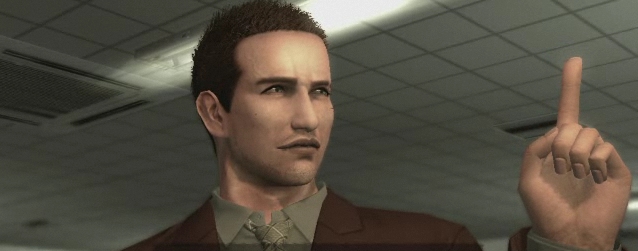
In Deadly Premonition, an open-world survival horror game for the 360 released a few months ago at the budget tier of $19.99 MSRP, players take the role of FBI Special Agent Francis York Morgan, or York, an expert criminal profiler who visits a small western seaboard-inspired town to investigate a young woman’s odd murder. He is supported by an alternate psyche in his mind named Zach that he is willing to talk to in front of anybody. He collects important leads from visions in his coffee. He seems to pull out a new cigarette once every 15 minutes. There is a name for each main character for every letter of the alphabet. Oh, and he also fights backwards walking black and white zombies that stick their hands down his throat.
If that’s all developers can come up with these days, they need to try harder.
Deadly Premonition inhabits a unique position in the current zeitgeist of gaming opinion. I think the easiest way to show this is to highlight two contrasting overall views on this game:
- Here’s IGN’s take on the game. On their 10 point scale, it is a 2.0 (“Terrible”). Bad graphics, bad audio, bad gameplay. I really like his opener: “Deadly Premonition is the definition of a system seller. Once you play it, you’ll want to go sell your system.”
- Here’s Destructoid’s take on the game. On their 10 point scale, it is a 10 (“10s are as close to perfect as you will get in a genre or on a platform. Pure, untarnished videogame ecstasy.”). It is an absolutely bizarre experience to him, and he loves it. His rating is a reflection of how entertaining the game is to him: “This game is so bad, it’s not just become good. It’s pretty close to perfect.”
It would be easy to throw your lot with one view or the other and call the competing view totally rubbish, but I believe the reality of this is that both reviews are on the money.
Games can easily be ranked through its individual, tangible elements, and that’s what most reviews tend to highlight. IGN’s review of the game is no exception. Erik Brudvig goes step by step in eviscerating the game’s story, audio, visuals, and gameplay mechanics, and I can’t say he is inaccurate in his assessments. Both Deadly Premonition’s open environments and the closed, linear missions are lined with blurry, low-quality textures and both character and object models feature goofy, amateurish geometries. The weird sound effects, the inappropriate music, and the recordings of characters talking vary wildly in volume and quality. Vehicle control is one giant train wreck that you have to experience for long, forced stretches at a time. The story can be inefficiently random and senseless. The list goes on. By the standards video games are usually measured up against, Deadly Premonition is not a good game.
Destructoid’s Jim Sterling elects to judge this game on a different basis, however. He acknowledges that the game would be identified as “bad”, but instead his opinion on the game is by the sheer entertainment that he’s getting from it. The unique mechanics, story, characters, writing, music, and everything else do add up to a massively unique and entertaining experience. Even though I think both reviews are valid, I lean towards Sterling’s viewpoint on this game.
Even with a fresh copy of Read Dead Redemption, Rockstar’s latest epic achievement in gaming, and a giant pile of summer homework, I was spending extra spare hour trying to solve the game’s myriad mysteries.The quality elements people search for in most games are definitely lacking in Deadly Premonition, but there’s something else present in the game that attracts me to it. One place to look to is at the central, eccentric mind behind the game, SWERY, a Japanese designer with an odd pseudonym who likes to leave his own inimitable streak on his work. The creators behind games like this and No More Heroes (designer: Suda 51) put in a sort of passion that is rarely found in other titles. It’s hard to tangibly identify it in the game, but the way every element of it comes together gives off that feeling that the developers are putting so much of their hearts and minds into the product and that can’t be discounted against them.
All the gameplay mechanics are a good show of this. On the most visible top level, the game controls much like Resident Evil 4, with “tank”-like movement and over-the-shoulder weapons aiming. Health is maintained using health kits in the inventory. On top of that, players have to sustain York by eating food and getting sleep. There is a lot of different food in this game, all with unique models, descriptions, and different values of satiety. Players can sleep to regain strength or just to pass the time, as the game world runs on a clock that runs in real time (1 minute in the game lasts 1 minute in real time), and certain events and people are only available at certain times. Players can earn small cash bonuses for doing menial tasks, such as driving a long distance, eating lunch, and shaving (York grows a beard over time without attention.) Open world exploration involves lots of driving, and there is a huge collection of cars to buy and unlock, each with varying characteristics and different music that plays while you’re driving. Cars also have limited fuel and can take some damage before breaking down.
The writing deserves special mention. The story is completely insane. I don’t even want to detail it any further in fear that I would ruin the surprise for somebody, but the word “insane” encompasses everything that happens. It barely holds together and it barely even makes sense at times, but it is immensely entertaining, and that’s what I’d want out of a game anyways. A surprising majority of the game is completely voice acted as well. Even alternate scenarios, such as whether you arrive at a location with a particular character or not, have different lines of dialogue and are voice acted.
Special mention goes to the music, as well. These songs are have a charm to them as they are varied in style, and while they tend to play at wildly inappropriate situations, that tends to add further to its charm.
Despite the very real and obvious flaws Deadly Premonition has, this much attention and detail put into a game through the best efforts of the developers cannot be ignored. Not everybody who tries it would become a fan either; I even hesitate to say a majority of people would like this game. The passion contained herein shouldn’t be ignored, however. People with similar passions for the limits that video games can reach should see this for themselves.
![[主页]'s avatar](https://0.gravatar.com/avatar/f7a877f21e16a0bb5a349e369bbec98adcf60db87000dedd159c67f9f02b2213?s=48&d=identicon&r=G)


 Inflection Pixel
0 Responses to “Deadly Premonition: Ignoring the Standards”